

The HK40 vs HP alloy question comes up every time a reformer is retubed, and it is rarely a close call once the operating envelope is on the table. The two grades are separated by about a generation of metallurgy.
HK40 is the older austenitic grade, nominally 25 per cent chromium and 20 per cent nickel. HP is the heavier alloyed successor at around 25 chromium and 35 nickel, and it is usually supplied modified with niobium.
This article compares them on the five things that decide a furnace campaign: creep strength, carburisation resistance, weldability, ageing behaviour and cost in service.
On this page
- Where each grade came from
- HK40 vs HP alloy on the five things that matter
- The comparison in one table
- What changes in the furnace when you switch
- How the two grades age differently in service
- When HK40 is still the right answer
- Where the micro alloyed grades fit
- Getting the comparison right for your furnace
- Questions we are asked most often
Where each grade came from
HK40 dominated reformer tube supply for decades and many furnaces still running today were built with it. For the outlet temperatures of the time it was entirely adequate.
Plants then pushed outlet temperature and throughput upward to gain capacity. HK40 began to limit what a furnace could do, and the higher nickel HP grades took over new build and most retubing.
Both grades are covered by ASTM A608/A608M, the specification for centrifugally cast iron chromium nickel high alloy tubing for pressure application at high temperatures.
HK40 vs HP alloy on the five things that matter
Creep rupture strength
This is the decisive difference. At reformer metal temperatures, HP modified carries meaningfully more stress for the same rupture life than HK40.
The practical consequence is choice. The same duty can be met with a thinner wall, or the same wall can buy a longer life, or the furnace can run hotter for the same life.
Thinner walls bring a second benefit that is easy to overlook. Less wall means a smaller temperature gradient through it, which lowers mean metal temperature and compounds the gain.
Carburisation resistance
Nickel content is the main defence against carbon ingress from the process gas, and HP carries far more of it.
HK40 carburises more readily at the bore. The affected layer becomes hard, brittle and magnetic, and it cracks under thermal cycling, giving creep damage a head start.
Plants that run low steam to carbon ratios, or that trip often, feel this difference more than plants that run steadily.
Weldability and field repair
Here HK40 has a genuine advantage, and it is the one argument for the older grade that holds up.
HK40 is generally more forgiving to weld, particularly on repairs to aged material in the field. HP modified needs tighter control of procedure, filler and heat input.
For plants that carry out their own field repairs with limited specialist support, that difference carries real weight.
Ageing and embrittlement
Both grades age in service. Carbides coarsen, secondary phases form and room temperature ductility falls, which is why aged tubes are handled carefully during outages.
HK40 is the more prone to sigma phase formation, which embrittles the material further. HP modified is less susceptible, though not immune.
This mainly affects handling and repair rather than operating strength. Aged tubes of either grade should not be assumed to behave like new material when moved or cut.
Cost over the campaign
HP costs more per kilogram, driven mostly by nickel. Judged on purchase price alone, HK40 wins.
Judged per year of service the comparison usually reverses, because the thinner wall reduces the mass bought and the longer life spreads the cost over more hours.
Add the value of one avoided unplanned outage and the arithmetic stops being close.
The comparison in one table
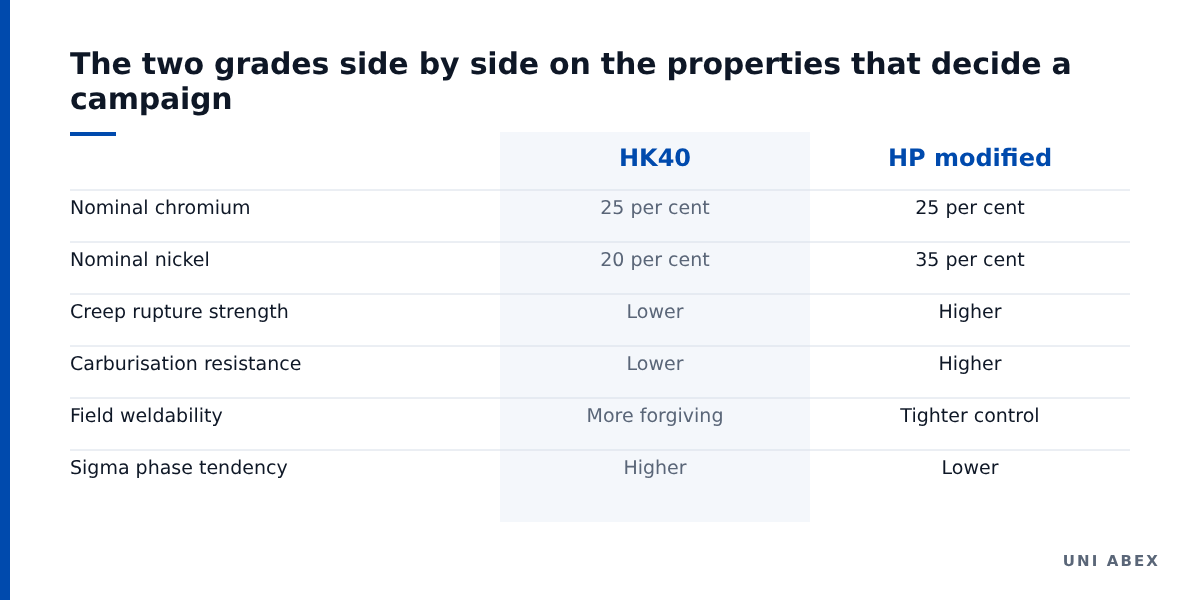
| Property | HK40 | HP modified |
|---|---|---|
| Nominal chromium | About 25 per cent | About 25 per cent |
| Nominal nickel | About 20 per cent | About 35 per cent |
| Creep rupture strength | Lower | Higher |
| Carburisation resistance | Lower | Higher |
| Weldability for field repair | More forgiving | Needs tighter control |
| Sigma phase tendency | Higher | Lower |
| Price per kilogram | Lower | Higher |
| Typical current use | Legacy and lower duty | Primary reformers |
What changes in the furnace when you switch
Changing grade is not only a purchasing decision. Several things move with it, and they are easier to deal with before the order than after delivery.
Wall and bore. If the higher strength is taken as thinner wall, the bore grows. More catalyst volume in the same outside diameter changes conversion, pressure drop and flow distribution.
Weight. Thinner walls mean lighter tubes. Spring hangers and support systems are set for a given load, and a significant change in tube mass needs checking against the original design.
Thermal expansion. The two grades do not expand identically. Where tubes of different grades share a furnace, differential movement at the harp is worth reviewing rather than assuming.
Inspection baselines. Growth thresholds and eddy current interpretation are grade dependent. Carrying over the old acceptance criteria to new tubes produces misleading conclusions.
Welding procedures. Procedures qualified for the older grade do not transfer. This covers both shop fabrication and any field repair capability the plant maintains.
None of these is a reason to avoid the change. They are simply the items that belong on the engineering checklist alongside the price comparison.
How the two grades age differently in service
Both grades leave the works with a cast structure that changes from the first day at temperature. How they change differs, and it shows up in inspection.
In HK40, carbide coarsening is accompanied by a greater tendency toward sigma phase. That phase is brittle, and its presence is part of why older tubes need careful handling during outages.
In HP modified, the niobium carbides are more stable. Coarsening still happens, but more slowly, so a greater share of the original creep strength survives into the later part of the campaign.
For an operator the consequence is in the shape of the risk. HK40 tends to deteriorate more noticeably in its later years, so inspection intervals that were adequate early may not stay adequate.
Neither grade should be assessed on hours alone. Microstructural evidence from a sample of tubes is what turns an age into a condition.
When HK40 is still the right answer
It would be dishonest to present HP as correct in every case. HK40 still earns its place in three situations.
- Lower duty service where metal temperatures sit well below the limit and the extra strength buys nothing useful.
- Matching existing tubes in a furnace being partially retubed, where mixing grades in one harp is undesirable.
- Frequent field welding, where ease of repair outweighs creep performance.
Outside those cases, a modern primary reformer specified in HK40 today would be buying a shorter campaign than it needs to.
Where the micro alloyed grades fit
HP modified is not the end of the line. Micro alloyed variants add controlled amounts of further elements to refine the carbide structure and raise creep strength again.
For furnaces already running at the top of the HP envelope, that is the next step rather than more wall thickness. Our advanced alloy grade range covers these.
Whichever grade is chosen, the casting route matters as much as the chemistry. Soundness, grain structure and bore finish all come from how the tube is cast, not from the analysis certificate alone.
Getting the comparison right for your furnace
Generic grade comparisons only take the decision so far. The numbers that settle it are your own.
Bring the design metal temperature the existing tubes were calculated at, and the temperature the furnace actually runs at now. The gap between those two is usually where the answer lives.
Bring the current wall thickness, outside diameter and tube length, along with the operating pressure. Without those the wall for an alternative grade cannot be calculated honestly.
Bring the failure history too. Repeat failures in the same positions point at firing or catalyst rather than at the grade, and no alloy change will repair that.
With that set of inputs the comparison becomes a short calculation rather than a debate about metallurgy.
Questions we are asked most often
Can HP tubes be welded directly to existing HK40 tubes?
Dissimilar joints are made, but they need a qualified procedure and the right filler, and the joint becomes a named inspection point for the rest of its life. It is not a field decision.
Does HP always allow a thinner wall?
Usually, at the same duty and target life, but the calculation has to be done for your conditions. Pressure, design metal temperature and bore all feed into it.
How do I know which grade is in my furnace now?
Start with the original purchase records and heat certificates. Where those are missing, positive material identification on a sample of tubes will settle it quickly.
Does the higher nickel content create a supply risk?
Nickel price moves more than most alloying elements, and it is the main reason HP costs more per kilogram than HK40.
For a retubing project the sensible protection is to fix the quantity and the grade early, then ask for pricing against a defined validity period rather than assuming a figure quoted a year ago still holds.
Is HP modified the same as HP?
Not quite. Plain HP is the base grade, while HP modified carries deliberate niobium additions that raise creep strength. Most reformer supply today is the modified version.
Uni Abex casts both grades and the micro alloyed derivatives, with creep data and full certification against the heat. If the HK40 vs HP alloy decision is live on a retubing project, send us your operating conditions and we will run the comparison on your numbers.