

Ammonia plants are moving to micro alloyed HpNb tubes for one straightforward reason. The furnaces are being asked to run harder than the grade they were built with was chosen for, and extra wall thickness has stopped being a useful answer.
HpNb is HP modified with niobium. Micro alloying goes a step further, adding small and tightly controlled amounts of further elements to change how the carbide structure behaves over tens of thousands of hours.
This article explains what those additions actually do, the three gains they deliver in service, and the conditions under which the upgrade pays for itself.
On this page
- What niobium and the micro additions change
- Three gains from micro alloyed HpNb tubes
- Where the grades sit relative to each other
- Building the case for an upgrade
- What changes in day to day operation
- When the upgrade does not pay
- What to ask for on enquiry
- Why ammonia plants in particular
- Questions we are asked most often
What niobium and the micro additions change
Creep resistance in these alloys comes from carbides sitting where they obstruct movement within the metal at temperature. The useful ones are fine, well distributed and stable.
The problem is that carbides coarsen over time. As they grow and gather, they stop blocking creep and start acting as sites where damage begins.
Niobium forms stable carbides that resist this coarsening. Micro additions refine the structure further and slow the change, so the alloy holds more of its original strength deep into the campaign.
That is the whole mechanism. It is not a different material. It is the same family with its microstructure engineered to age more slowly.
Three gains from micro alloyed HpNb tubes
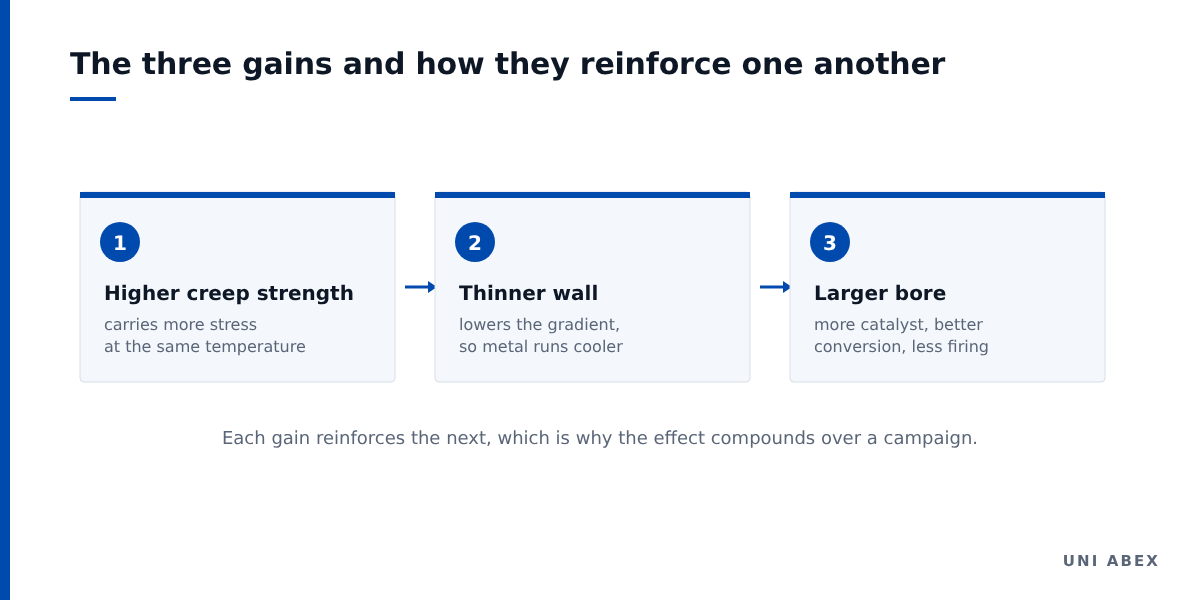
1. Higher creep strength at the same temperature
The direct gain is stress capacity. At a given metal temperature and target life, the grade carries more stress than standard HP modified.
That can be taken in three ways: a longer campaign at the same conditions, the same campaign at a higher outlet temperature, or a thinner wall for the same duty.
Most ammonia plants take it as outlet temperature, because that is what converts directly into capacity.
2. A thinner wall, which lowers metal temperature
This gain is indirect and is the one most often missed in a specification review.
Heat has to pass through the tube wall to reach the process gas. A thicker wall means a larger temperature drop across it, so the outside runs hotter to deliver the same duty.
Since creep damage is exponential in temperature, cutting wall thickness lowers mean metal temperature and buys life on top of the strength gain. The two effects reinforce each other.
A thinner wall also frees bore. More catalyst in the same outside diameter means better conversion, and better conversion means less firing for the same output.
3. Strength that holds up late in the campaign
Published creep curves describe material at the start of life. What matters to an operator is the condition of the metal at hour 80,000.
Because the stabilised carbide structure coarsens more slowly, the grade retains a greater share of its properties late in service. The curve flattens where it matters.
This is also why aged tubes of this type tend to handle better during outages, though no aged tube should be treated as new material.
Where the grades sit relative to each other
| Grade | Position | Typical use today |
|---|---|---|
| HK40 | Legacy austenitic grade | Lower duty and legacy furnaces |
| HP | Higher nickel base grade | Base for modified variants |
| HP modified, HpNb | Niobium stabilised | Standard primary reformer supply |
| Micro alloyed HpNb | Refined carbide structure | High outlet temperature duty |
All of these are supplied against ASTM A608/A608M for centrifugally cast high alloy tubing in high temperature pressure service, and the comparison between HpNb reformer tubes and the older grades is worth running on your own conditions rather than on generic curves.
Building the case for an upgrade
The decision is rarely made by the metallurgist alone, so the case has to be legible to people who will never read a creep curve.
Start with the constraint. If the furnace is limiting plant output because outlet temperature cannot be raised without shortening tube life, that is a production number rather than a materials argument.
Then put the campaign length beside it. A retube that lasts one more turnaround cycle removes an entire outage from the forward plan, and outages cost far more than tubes.
Then add the firing position. If better conversion lets the furnace meet the same output at lower firing, there is a fuel saving that runs every hour of every year.
What should not go in the case is a claim that the tubes will not fail. They will, eventually, like all reformer tubes. The argument is about when, not whether.
It also helps to be clear about what the upgrade does not fix. If the current tubes are being lost to burner alignment or catalyst condition, a stronger alloy delays the symptom and leaves the cause in place.
What changes in day to day operation
Operators sometimes expect a new grade to change the routine. Mostly it does not, but three things are worth knowing.
Inspection criteria move. Diametral growth thresholds and eddy current interpretation are grade specific. Carrying the old acceptance limits across to new tubes gives misleading results in both directions.
The temperature survey matters more, not less. A higher strength grade widens the operating envelope, which makes it easier to drift upward without immediate consequence. The discipline still pays.
Catalyst loading needs attention. If the bore has grown, the loading quantity and method change with it. Uneven packing in a larger bore produces the same hot bands as before.
Beyond those, the furnace runs as it always did. The gain is in how slowly the tubes consume their life, which is visible in trended data rather than in the control room.
When the upgrade does not pay
Micro alloyed grades cost more, and there are furnaces where that money is better spent elsewhere.
- Metal temperature well below the HP limit. If the existing grade is comfortable, the extra strength buys nothing you can use.
- Failures driven by firing or catalyst. A better alloy does not fix flame impingement or a dead catalyst bed. It just fails more slowly.
- Frequent field welding with limited support. The higher alloyed grades need tighter procedure control.
- Partial retubing of one harp. Mixing grades in a single harp changes flow distribution and complicates later assessment.
The honest test is simple. If trended pyrometer data shows the furnace sitting near the top of the existing grade’s envelope, the upgrade is worth costing. If the tubes are failing for operational reasons, fix those first.
What to ask for on enquiry
- Creep rupture data for the specific grade offered, not for the HP family generally.
- The design metal temperature the proposed wall was calculated at.
- Test results from the delivered heat, traceable to the castings supplied.
- The test method behind the creep curve, which should follow ISO 204:2023.
Ask also how the tube is cast. Chemistry alone does not produce creep performance. Soundness and grain structure come from the casting process and the control around it.
Why ammonia plants in particular
Hydrogen, methanol and direct reduction plants use the same tubes, so it is fair to ask why ammonia service comes up most often in these conversations.
Part of it is age. A large share of the world ammonia fleet was built decades ago and has been debottlenecked repeatedly since, so the furnaces now run well beyond their original design intent.
Part of it is economics. Ammonia output is closely tied to reformer duty, so a furnace that limits outlet temperature limits the whole plant, and that shows up directly in annual production.
Part of it is operating pattern. Ammonia plants often run long steady campaigns, which rewards an alloy that holds its properties late in life rather than one that merely starts strong.
The same reasoning applies wherever a reformer has been pushed past its original basis. Ammonia is simply where that situation is most common.
Questions we are asked most often
Is HpNb the same as HP modified?
In practice the names overlap. HpNb makes the niobium addition explicit, and most HP modified supplied for reformer duty is niobium bearing. Micro alloyed versions go further again.
Will a thinner wall reduce the design margin?
No, if the wall is recalculated properly for the new grade at your conditions. The margin comes from the calculation basis, not from the thickness in isolation.
Can existing harps take the new tubes?
Usually yes, since outside diameter and overall length can be held while the wall changes. Fit should still be confirmed against the furnace drawings before anything is ordered.
Does a micro alloyed grade need different inspection?
The techniques are the same. What changes is the interpretation, because growth thresholds and eddy current response are specific to the grade and wall.
Agree the acceptance criteria with your inspection contractor at the time of installation rather than at the first outage, and record them alongside the heat numbers.
How long does a retube with these grades take to supply?
Longer than a stock item, because the tubes are cast to order, machined, welded into assemblies and certified. Ask for a current lead time early in the turnaround planning cycle.
Uni Abex develops and casts micro alloyed HpNb tubes at its own works, with creep testing and metallography in house. If you are weighing an upgrade for the next campaign, see our reformer tube range and send us your operating data for a like for like comparison.