

Reformer tube design life is almost always quoted as 100,000 hours, which works out at about 11.4 years of continuous running. That figure appears on nearly every data sheet in the industry, and it is widely misread.
It is not a warranty. It is not a prediction of when a tube will fail. It is the output of a calculation made against a fixed set of assumptions, and the gap between those assumptions and your furnace is what decides how long your tubes actually last.
This article explains what the 100,000 hour figure contains, why real service life lands above or below it, and how to form a defensible view of the life left in the tubes you have.
On this page
- What the 100,000 hour figure actually means
- Why reformer tube design life and service life diverge
- Estimating the life left in tubes already in service
- A worked way of thinking about it
- What shortens life fastest
- Buying more life without buying more wall
- What to ask a supplier
- Questions we are asked most often
What the 100,000 hour figure actually means
Reformer tubes are sized by creep rupture, not by yield strength. The designer picks a target life, reads the stress the alloy can carry for that duration at the design metal temperature, applies a factor, and arrives at a wall thickness.
So 100,000 hours is an input to the sum, not a result of it. Change the target to 150,000 hours and the required wall gets thicker. Change the design temperature upward and it gets thicker again.
The method is standardised. For refinery heater tubes the reference document is ISO 13704:2022, calculation of heater-tube thickness in petroleum refineries, which sets out the elastic and rupture design approach in full.
Three assumptions sit underneath the number, and all three are worth testing against your own plant.
- A single design metal temperature held for the whole life, not a range and not a drifting average.
- Steady operation, with thermal cycling treated as negligible.
- Minimum specified creep properties for the grade, as cast and as delivered.
Why reformer tube design life and service life diverge
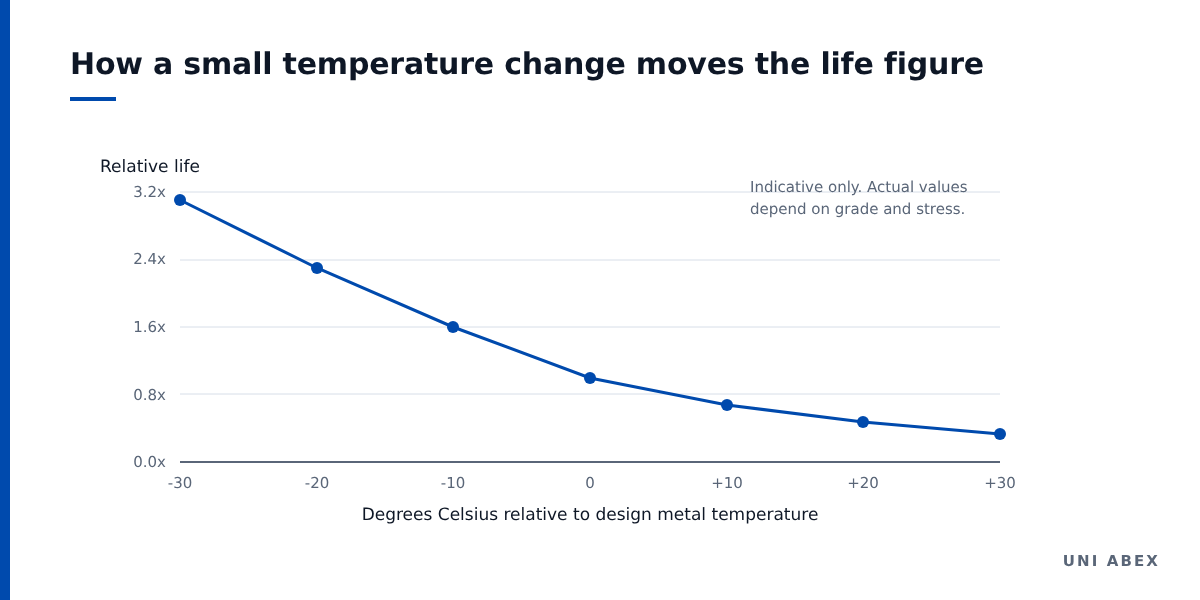
The dominant variable is temperature, and the relationship is not linear. Creep damage accumulates exponentially with metal temperature, which is why small survey errors matter so much.
As a rough working guide used across the industry, running 15 to 20 degrees Celsius above design metal temperature roughly halves remaining life. Running the same amount below it can double the figure.
That single sensitivity explains most of what operators observe. A furnace held carefully below design temperature can take tubes past 130,000 hours. A furnace pushed hard for throughput can lose them at 60,000.
Cycling is not in the calculation
The design sum assumes steady running. Every trip adds strain at welds and transitions that the hours alone do not capture.
Two plants with identical tubes, identical firing and identical hours will not have identical tubes at the end if one of them tripped forty times and the other tripped four.
Delivered properties sit above the minimum
Design uses the specified minimum creep strength for the grade. Real castings usually test above it. That margin is genuine and it is one reason tubes often outlast the quoted figure.
It is also why the test certificate matters. A tube whose creep data sits comfortably above the minimum is carrying extra life that never appears on the data sheet.
Estimating the life left in tubes already in service
Remaining life assessment is not a single measurement. It is an argument built from several sources that agree with each other.
| Input | What it tells you | Limitation |
|---|---|---|
| Operating hours | Baseline against the design figure | Ignores how the hours were spent |
| Temperature history | The real driver of damage | Only as good as the survey discipline |
| Diametral growth | Accumulated creep strain | Needs repeatable measurement positions |
| Eddy current results | Subsurface damage and cracking | Interpretation varies by operator |
| Replica metallography | Creep stage in real material | Destructive or sample based |
| Trip count | Cycling contribution | Rarely recorded properly |
Where these disagree, trust the metallography. Hours are an accounting figure. Microstructure is physical evidence.
The creep data that underpins the whole exercise comes from standardised tension testing, described in ISO 204:2023. Knowing which standard produced a supplier curve is a fair question to ask.
A worked way of thinking about it
Take a furnace commissioned with a 100,000 hour design figure at a stated design metal temperature. It has now run 70,000 hours. The question is whether the next campaign is safe.
Hours alone say 30,000 remain. That answer is almost useless on its own, because it assumes the furnace ran exactly at design temperature for every one of those hours.
So the first correction is temperature history. If surveys show the furnace averaged 15 degrees Celsius above design through the middle years, the consumed fraction is far higher than 70 per cent and the remaining figure shrinks sharply.
If instead the furnace ran below design because throughput was limited by something downstream, the consumed fraction is lower and there may be considerably more than 30,000 hours in hand.
The second correction is physical evidence. Diametral growth gives accumulated creep strain, and replica metallography puts a creep stage against it. Where the calculation and the microstructure disagree, the microstructure decides.
The third correction is distribution. A furnace does not have one life. It has as many lives as it has tubes, and the campaign is set by the worst row rather than the average.
This is why a credible assessment reads as a range with a stated basis, not as a single number. Anyone who hands you one figure without the assumptions behind it is guessing in a confident voice.
What shortens life fastest
Ranked by how much damage they do per unit of operator attention, the list is short.
- Firing above design metal temperature to hold throughput as catalyst ages. This dominates everything else.
- Burner misalignment producing local hot spots that bulk temperature readings never show.
- Catalyst problems that remove the cooling effect of the reaction and create hot bands.
- Frequent trips that add strain at welds and transitions outside the design assumption.
- Low steam to carbon excursions that carburise the bore and reduce toughness.
Four of the five are operational rather than metallurgical. That is the useful conclusion. Most lost life is bought back with firing discipline and survey routine rather than with a purchase order.
Buying more life without buying more wall
The instinct when tubes fall short is to specify a thicker wall. It is not usually the best answer.
Thicker walls raise the through wall temperature gradient, which pushes the mean metal temperature up and partly cancels the gain. They also add weight and cost, and they reduce the bore available for catalyst.
A higher creep strength grade is often the better route. Moving from an older grade to a micro alloyed one can deliver the same life at equal or thinner wall, and sometimes allows a larger bore. Our micro alloyed grade range is built around that trade.
The cheapest option of all is firing discipline. Holding metal temperature 15 degrees Celsius lower costs nothing in capital and can return more life than any specification change.
What to ask a supplier
- Which design metal temperature was the wall calculated at, and does it match your operating reality?
- Which creep curve was used, and from what test programme?
- What does the delivered material actually test at, not the specified minimum?
- Which standard governs the casting, and is the test certificate traceable to the heat?
Centrifugally cast tubing for this duty is supplied against ASTM A608/A608M, the specification for centrifugally cast iron chromium nickel high alloy tubing for pressure application at high temperatures.
Questions we are asked most often
Is 100,000 hours a guarantee?
No. It is a design target used to size the wall. Commercial warranty terms are separate and far shorter, and they are agreed per contract rather than implied by the design figure.
Can tubes safely run past their design life?
Many do, and run well. Passing 100,000 hours is not a reason to replace on its own. The decision should rest on measured growth, inspection findings and creep stage, not on the calendar.
Does a thicker wall always mean longer life?
Not reliably. Extra wall reduces stress but raises the temperature gradient through the wall. Beyond a point the two effects offset, and you have paid for weight rather than life.
Do all tubes in a furnace share the same life?
No, and this is where single figure estimates mislead most. Tubes in different positions see different heat flux, different flow and different catalyst condition.
The campaign is set by the worst performing row rather than by the average of the furnace. Assessments that report only a mean value hide the tubes that will decide the next outage date.
How often should remaining life be reassessed?
Every major turnaround, using the same methods and the same measurement positions each time. Comparability between assessments matters more than the sophistication of any single one.
Uni Abex has cast reformer tubes for hydrogen, ammonia, methanol and direct reduction service for five decades. If you want a second opinion on a reformer tube design life calculation or a remaining life case, see our reformer tube range or send us your inspection data.